Returning for this year’s London Palestine Film Festival, Yasmin Fedda’s 2020 documentary about two men forcibly ‘disappeared’ by the Syrian Government, led by the now-ousted Bashar al-Assad. Five years after its release, the hope and perseverance of their loved ones to find answers burns as bright as ever.
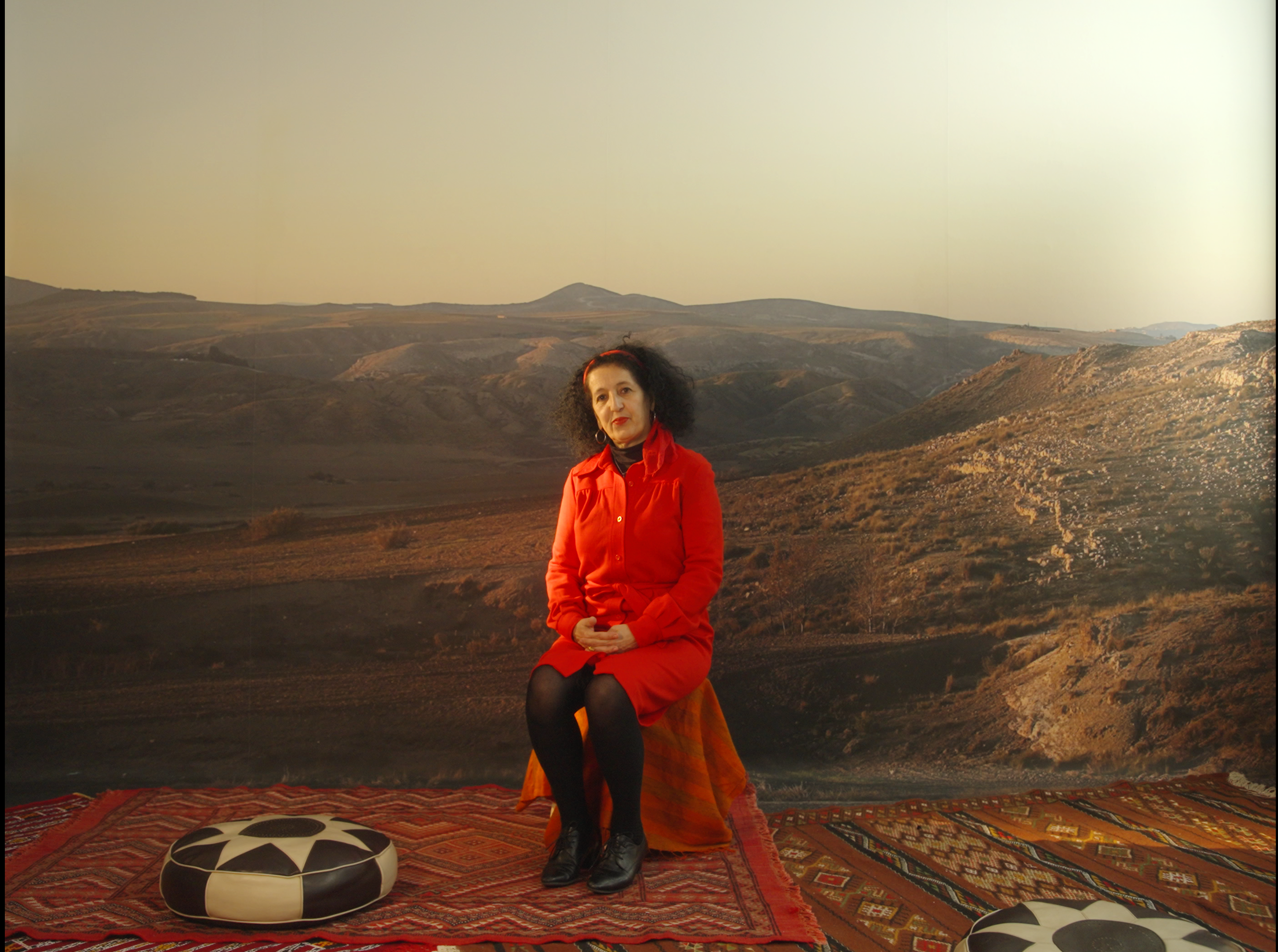
The film jumps between the lives of two men, Italian Jesuit Priest and opposition ally Paolo Dall’Oglio, and Palestinian-Syrian open-source software developer Bassel Safadi, in the months leading up to their forced disappearance in 2013 and 2012, respectively. After the fact, the film pivots to Machi, Paolo’s sister, and Noura Ghazi Safadi, Bassel’s wife, in their united effort, along with others, to find answers to their disappearances.
But the film is deliberately unfaithful to this chronology. Finished and released during the COVID-19 pandemic, Ayouni has the air of a social media feed—the world’s tool for existence at the time. Structured and edited sporadically, jumping from amateur footage of protester/military clashes as well as smaller moments between Bassel and Noura, to documentary footage (as well as behind-the-scenes) that spans over a decade, to news footage of Paolo speaking out against aggressors. The barrage of images seems to circle a centre, an invisible centre which, as the documentary progresses, seems to represent this forced removal from the public eye. The title is a reference to this despairing fact, ayouni translating to “my eyes,” used as a term of endearment in Arabic.
The film premiered at CPH:DOX in 2020. There, it was in the running for the F:ACT Award, dedicated to films “between documentary filmmaking and investigative journalism.” The nature of the investigation in Ayouni feels tragic, as they never find the very objects of everyone’s search (the two men). But, through this pain, Ayouni offers a playbook on how to unite in the face of an unbeatable opposition—the re-screening at LPFF, post-ousting of Assad, seems only to be a testament to this.
The efforts that Fedda documents to find these men are, in many ways, a differend. That is to say that, along the lines of Jean-François Lyotard’s original idea, the reality of persecution is nullified because those who can provide the testimony have perished under it. But for Lyotard, this is not without hope; a new language of “differend” (or, “dispute”) must be invoked to sidestep this double bind. This is arguably why Ayouni has been lauded so highly not only as a film but as a contribution to documentary cinema, for the way it foregrounds the metrics of a social media regimen of communication that, while sporadic, can help uncover truths that have been forcibly taken away by hegemonic powers.
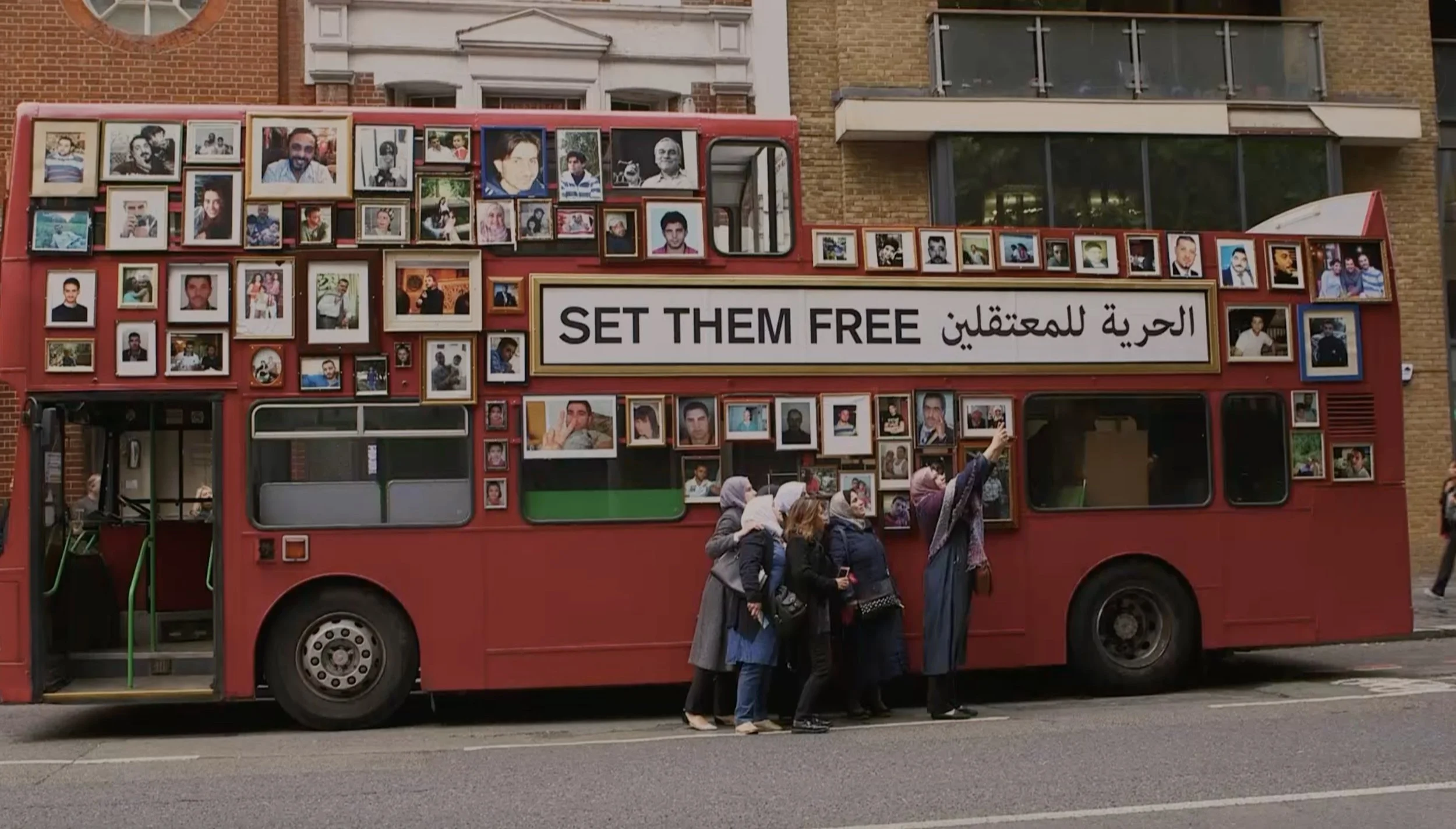
Fedda’s film has clearly left a mark, with more filmmakers exploring online communication as an alternative form of resistance. Just like the bus, covered in framed photos of the ‘disappeared’, social media allows for the movement of images as a means of phrasing the unuttered. It’s screening at LPFF 2025 is proof that this skill is still very new and underdeveloped, but with the potential to be very powerful.
Image © London Palestine Film Festival.